Tuesday, February 26, 2013

Lil' Ol' Harrington

Harrington is a small town situated in the heart of Lincoln County in Washington state.  It is part of Big Bend wheat country and sits on the Great Northern railway.  Sitting just over 20 miles from Sprague and 50 miles west of Spokane, Harrington has grown steadily over its history.  The town today has a high school (which it shares with Sprague), city park, opera house, and a top five nationally ranked classic car restorer.  The hotel is currently under renovation and hopes to be open for business in the near future.

A Studebaker "Bullet Nose".  Courtesy of Crews News.

Harrington was settled in the 1880's by homesteaders and was said to have some of the best soil for growing wheat in the territory.  One year a farmer sold his crop for over a whopping $200,000 (equivalent to about $5-$6 million today).  The city has its own grain elevator and in some high yielding years the silos were packed full and excess grain was put in massive piles next to the silos, until room was made to pack it in.  In the early years the wheat industry was modest due to the fact that crops had be hauled the 20 miles to Sprague to be sold.  That all changed though when Harrington was chosen as a stop for the Great Northern Railroad.  Farmers now had a direct line to sell their grain, cutting down cost and travel.

Wheat harvest in early Harrington.  Courtesy of Harrington.

The city began to boom with the arrival of the railroad.  Land prospectors from California showed up to purchase plots of land, believing they would rise in value with new train depot.  They were right and over the next 80 or so years Harrington saw a steady raise in population growth.  With multiple passenger trains coming and leaving the city several times a day, people began leaving Spokane to come enjoy a day or night in Harrington.  The opera house (which is more of an auditorium with seating for a couple hundred) was bringing in traveling acts to perform with regularity.  Many of these traveling acts signed and dated their names on the walls backstage and in the dressing rooms, many of which are still legible today.  In these booming years in Harrington, the hotel was never empty and the liquor was flowing.  It is said that in his youth famous Spokanite, Bing Crosby, used to come out to Harrington with his brother for nights of drinking and singing.

Bing Crosby singer from Spokane.  Courtesy of Wikipedia.

On our trip Saturday to Harrington, we visited the Electric Hotel, the Harrington Opera House, the legendary Studebaker shop, and took a stroll down the main street seeing old city hall and the old saloon.  The town has that very refreshing small town feel to it; everybody was friendly and knew everyone (probably why every car rolled by slow to inspect us outsiders).  Every building we toured was a living museum.  The Studebaker shop was packed full of cool,old, rare cars; one of them he was working on is only one of six left in the world.  In the owners office he had other old relics, not all associated with cars; an original Mr. Potatoe Head still in the box and my favorite, old baseball cards including hall of famer Whitey Ford.  The opera house was filled with old cast pictures, hand painted back drops, and the hundreds of performer's names.  The owners still put on plays and performances on the old stage, sometimes a couple times a week, mostly by the local high school drama club.  At the time of our visit the hotel didn't look much like a hotel, more of a worksite.  You can tell owners, Jerry and Karen, are putting their heart and soul into the project and I can't wait to see the final product.  I'd like to thank everyone we met in town for their hospitality and informative tours of the town.

Hall of Fame Yankees pitcher Whitey Ford.  Courtesy of Hall of Fame Memorabilia.

On a creepier note, the story about the Shelby girl who died at 13 in Harrington, I'm pretty sure I saw her gravestone while we were wandering through the cemetery.  Also a few of the names of old citizens in the 100 years of Harrington book stuck out as familiar.  Did anyone else who went on the trip notice this?

Monday, February 18, 2013

The New South is the Old South

After reading the first half of Confederates in the Attic: Dispatches from the Unfinished Civil War by Tony Horwitz, I've come to the conclusion that I would be fine if the South seceded again.  The book starts out nice enough with the reenactors in Virginia.  These seem like very nice men who look at the Confederacy for the historical aspects of the time.  They are a little weird in real life I'm sure, but they're just trying to relive history and you can't knock them for that; it's their hobby and they're not alone in the activity.  I liked what one of them had to say about why he does the reenactments, this isn't an exact quote but close: "I think we all feel a little guilty in the time we live in, it was harder back then so it makes us feel better if only 48 hours."  I don't know about the whole spooning train thing to sleep (call me "farb" I don't care), but these men are, (along with a few smaller acquaintances of Horwitz) the only people introduced so far who have the right idea of how to remember the Confederacy.  They offend no one, and keep it all about the war not a return to antebellum society.

The deeper South Horwitz goes, the more irritated I became.  The first part that made me apologize for America was the group he met with who was trying to keep the Rebel flag on the South Carolina capitol building.  These were some of the more ignorant people around.  They weren't even from the South, most of the protest leaders were from New England, and a couple were Jews.  The worst of all though was Walt.  Walt invited Horwitz to his home (trailer) to chat.  I would have loved to be there with Horwitz for this encounter.  Walt gets up on his soapbox and just starts off on his prejudiced tangents, including a hatred for Jews.  At this point you can almost see the grin on Horwitz face as he's shaking his head about to inform Walt that he was in fact a Jew.  Even in the reading there's an awkward silence and Walt asks what his last name is, and he responds, "i should have guessed."  That wasn't even the worst part.  Walt spends this whole time trying to convince a Jew about intolerance, and the last thing he brings up completely discredits his entire argument.  Walt decides to tell Horwitz his approach to life and politics: essentially, if the government supports it, I don't.  One of the most ignorant quotes I've ever read in a book.  Walt, I hope you're still somewhere in the Lowlands of South Carolina and haven't met a women willing to bear your seed yet.

South Carolina flag.  Courtesy of 50 States.


The title of this post is no more prevalent than in the chapter of Guthrie, Kentucky/ Tennessee.  You wanna know why the rest of the world hates us?  Look at the scene at Redbone's (the biker bar).  Granted I have no idea what Horwitz was thinking going there in the first place, but the people he encountered there are just a black eye on society.  The only decent one was the owner for not letting Tony get stomped out by that cross faded Harley rider; even then though his name is Redbone and he allows that place to exist to make a buck, so he's not exactly an upstanding citizen.  It's people like them that get me going, they shit on everyone elses cultures, beliefs, etc but once theirs get questioned then that's crossing the line. There's more to swastikas and Confederate flags than being rebellious; rebellious isn't a bad thing but the history of those two symbols isn't something that should be idolized, there's a sad and violent history that follows them.

Sesame street's Bert with a member of the KKK.  Courtesy of Bert is Evil.


The Michael Westerman murder was an interesting chapter.  At first I was sympathetic toward Michael, his family, and the whole situation, but as the chapter went on I began to realize a 19 year old new father was killed and people began using it as propaganda.  The KKK and Aryan Nation got involved and it turned into a money grab.  The family allowed it to happen too.  They turned this kid into a martyr for 130 year old cause.  He never knew the meaning of the flag he flew from his truck; I mean he drove it through a black neighborhood on MLK Day in a town he grew up in, he knew where he was.  His wife (who find more ignorant than him) even said he put the flag up because it made his truck look "sharp."  Every memorial service for Michael the story changed.  Michael went from a naive kid just looking to make his truck look slick, to a Confederate martyr who was obsessed with his old South lineage and for what: money and a PR move.  I'm not condoning whatsoever what Freddie and his friends did to Michael.  They could have dropped it and just let him be an inconsiderate, ignorant teen who was just showing off, or at worse pull him from his truck and beat him up; at least that way no one is dead and no 17 year olds would be serving life in prison. The whole situation is messed up and everyone involved made the wrong decision in how to handle it, including the families and the organizations that showed up to support either side in the case.  No one had to die, no one had to go to jail, but to ignorance and poor decisions someone is.

Confederate battle flag.  Courtesy of usflags.org.


I Don't know why it's been so hard to include minority history into our countries history.  It all happened you can't deny it.  It happened within our borders, why is it trying to be hidden?  I don't blame the whites for this discrepancy all together, minorities could have helped get their history out as well.  The Biddy Mason project was decades too late; the church burnt down in the 1890's and no one made an effort to immortalize her until the mid 1980's.  In a city like LA with a large minority population how did this happen?  It took four white women in 1985-86 to actually get this memorial done.  The absence of black and Indian stories in historic sites across the country is appalling.  Yes it's a violent, shameful history at most of these places, but it happened you can't deny it, there's records of it,  what are you trying to hide?  We are entering a time in which this is changing and I for one am happy and will help to this hopefully with my degree and future career in history.

I'm sorry if I offended anyone in class who read this, with ties to the South.  I know there are great people down South and this is just a small minority of the population.  I'm not trying to say to abandon your roots, culture, or history.  Embrace where you've come from, just know that certain aspects of history can be interpreted different ways by different groups of people and sometimes it's just better to keep your mouth shut.  Black, brown, yellow, red, or white, we all have our own opinions that are important to us, but to keep the peace and keep moving forward we need be aware of the good and bad aspects of our respective histories.          

Monday, February 4, 2013

Looking Back, While Moving Forward

Everything in this world must adapt to the times, and history is no different.  Whether it's sports, politics, whatever, the "new" way will be the "old"way by tomorrow.  You can't become complacent.  For the field of history this means joining the technological world.  We can't fall behind the times and get lost in the shuffle.  Call it academic natural selection; only the strong survive.  At first, history was a little slow to see the benefits computers and the web could have on preserving our past.  Since the late 90's however some great strides have been made and digital archive websites have been popping up everywhere.  As the internet becomes more and more available and easier to use this field should explode, allowing our society to literally never forget anything. 

Old books and paper documents aren't built to last forever.  Courtesy of The Private Library.

In his essay "On the Web: The September 11 Digital Archive," James T. Sparrow chronicles the creation of one of our most important digital archive sites, the 9-11 Digital Archive .  Sparrow was one of the leaders in developing this site, and explains what makes and breaks sites like these.  In my opinion, he spends way too much time explaining the software, code, etc. of what went into the site.  While that's important, this is a history book, so more time should have been spent explaining what the pros and cons of digitizing our history could mean for our future. 

This site depends on contributions from the public.  People from all around the US can share their memories, photos, home videos, etc. of that fateful day in 2001.  As part of the ECHO (Exploring and Collecting History Online) program, the site has employees who sift through all the shared data and items and catalogs them correctly onto the site.  The benefit of having the public donate artifacts is that it allows people to have their personal experiences become part of US history.  Each item selected for the archive is number and cemented in its place in history.  A project like this would be doomed without the cooperation of the public; you wouldn't be able to get even a fraction of the stuff you'd need to make this viable.  As of 2006 (reprint date of Public History: Essays from the Field by Gardner and LaPaglia) there is over 140,000 items scanned, uploaded and cataloged on the 9-11 Digital Archive.

9-11 Memorial in NYC.  Courtesy of USA Today.

Beams of light into the New York sky representing the Twin Towers.  Courtesy of Lumination Network.

A con that Sparrow sees in the transition to digital history, is that it's making your everyday citizen an historian.  The transition is killing the need for, as Sparrow puts it, "experts."  If people can just browse the web and find primary sources on sites like these, what is the need for actual historians?

I see Sparrows point and think he's giving the public too much credit.  People are still going to rely on historians to do the hard research necessary write the books and make the documentaries the public uses to learn their history.  It's agreed that history is a dying breed.  I believe that sites like the 9-11 Digital Archive can help revive our field.  These sites give easy access to sources and artifacts, that before weren't readily available to the public.  The part of the public that will use these digital archives are hobbyist just generally interested in the past, high school and college students, and other historians.  These sites aren't going to flood the job market with historians. The digital archives just allow us to better preserve our past and makes it easier for a curious public to find a few more answers than before.  

The future of history.  Courtesy of JFK Library.
         

Tuesday, January 29, 2013

Preserving the past

Something that is becoming more and more difficult to do is preserving histories around our country.  The public school system doesn't help, giving our youth the highlights in the K-12 system.  Historic sites and buildings are being lost to strip malls, parking garages, resorts, office buildings, etc.  In 50 years whats going to be left?  I mean they almost put an Islamic mosque up at the site of the 9-11 attacks at Ground Zero.  It's all become about money and US history is becoming the victim.

So who's to blame?  Well there's the obvious in politicians; damn Reagan and his right winged agenda.  You could point to the school systems.  History isn't a stressed subject anymore and children don't care.  About a month ago, Los Angeles Laker star, Kobe Bryant, took his  team out for a movie night to watch the new movie, Lincoln.  After the movie, Kobe decided to put a tweet out.  It read along the lines of, "I was real surprised to see that some of the younger guys were shocked to see him get shot at the end."  If that's not a major problem in our society, then count me out I don't want to live on this planet anymore.  While politicians have cut funding and school districts have lost the passion, I believe the history preservation movement itself should shoulder some of this blame.

Professor Farnsworth from Futurama.  Courtesy of Memesters.


Don't get me wrong, in their early years they did some very good work.  The New Deal era was an incredibly important time for history preservation.  The WPA, CCC, HAPS and other groups like them served a great duty to this country.  They created our National and State Parks, created historical guide books that covered the entire nation, and preserved thousands of historical sites from east to west and north to south.  The problem i have with them is how they let the success go to their head.  Instead of providing a much needed service to our people as they did through the 50's and 60's, they switched drastically once it was realized there was money to be made.  They went from non-profit to big business (same thing i believe the NCAA is doing now, but that's for another time).  They began marking areas as historical districts in cities, skyrocketing the property values.  A lot of these districts were poor areas of the cities, and a lot of these people (many minorities) were forced out of the place they had called home for their entire lives because they couldn't afford it anymore.  What this is telling me is that in order to make a place historical you need to make it so the people responsible for the areas history can't afford to live there.  Something's wrong with that picture.  In doing so they made it more about the money than the history.  Manhattan is a great example of this forced migration.  Once a poorer part of New York City, it was dubbed a historical district and, much like in New Orleans French Quarter, its poor inhabitants were forced out to make room for the high class citizens who would pay top dollar for property. This movement lost it's morals and in the depressions of the 70's and 80's did what they could to support themselves and along with budget cuts in our government have put pieces of our history at risk.

Manhattan circa 1929.  Courtesy of New Construction Manhattan.


The movement did make some good decisions in the 90's, that has reclaimed some if its integrity.  For example teaming with environmental preservationists.  They are beginning to get back their roots, which I would like to see, not only for history itself but also for our current recession (and coming soon, my job hunt).  It did it once in the 30's, getting back to preserving our past could create thousands of jobs for historians, environmentalists, teachers, architects, English majors, and contractors.

In his essay "Interpreters and Museum Educators: Beyond the Blue Hairs," Mark Howell brings up an interesting topic.  It's a part of history preservation that seems to be a bit lost in the mix of things.  Howell is an interpreter for a museum; he's the one who gives the tours and puts the exhibits into context.  This may be the most important part of history preservation.  Ok, so you have the building it's been marked as a historical site, what now?  This is only half the battle; the other half will be achieved through the sites years of operations, through historians like Mark Howell who put it all in perspective.  They tell the public what  the big deal is about this venue; without them it's just an old building with a plaque somewhere saying it's important.  They are an irreplaceable part of history preservation and there is not nearly enough funding or jobs for these people.

I want to close with a quote from Howell's essay by historian G.M. Trevelyan, that to me explains the importance of history:
The poetry of history lies in the quasi-miraculous fact that once on this earth, on this familiar spot of ground walked other men and women as actual as we are today, thinking their own thoughts, swayed by their own passions but now all gone, vanishing after another, gone as utterly as we ourselves shall be gone like ghosts at cockcrow.
George Macaulay Trevelyan.  Courtesy of First World War.


Wednesday, January 23, 2013

M-I-C-K-E-Y M-O-U-S-E

Mickey Mouse history, what is it?  It's a term that defines trivial history.  History you knew as a young, wide eyed 4th grader.  It's the good, not the bad.  It focuses on our heroes and not the people our heroes had to overcome.  One of the best examples of Mickey Mouse history is the belief that Christopher Columbus discovered North America.  Walt Disney may very well be the father of Mickey Mouse history.  At Disneyland and Disney World he created his own version of historical exhibits.  He wanted Americans to remember their past, but focused on the good, not bad.  From his historical views and empowered by his celebrity, Walt has been able to push a certain view of US History to our youth.

One of Disney's first exhibits was his Hall of Presidents.  Disney uses the best available technology of the time.  He shows an informational video before revealing the exhibits main attractions.  Once the video ends, a group of robots appears on stage, all resembling one of the US Presidents.  Walt originally had this vision in 1957-58, but lacked the technology to bring it to life.  It wasn't until 1970 that the Hall of Presidents became a permanent attraction at Disney parks; although it made an appearance in the 1964 World's Fair.  Abe Lincoln becomes it's centerpiece.  They focus on George Washington and Andrew Jackson putting down rebellions and denying evil intentions toward society, yet a mention of both being slaveholders is never mentioned.  Walt Disney decided to only focus on what people wanted to hear; he leaves out anything unadmirable and aims for entertainment value.

Hall of Presidents today.  Courtesy of Talk Disney. 
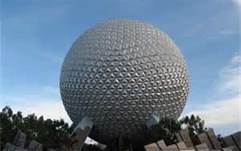
Perhaps Walt Disney's greatest vision was the EPCOT Center in Orlando.  Originally it was not meant to deal with history.  It was supposed to be an artificial community in which 20,000 people would live and serve as Disney's own utopia.  He soon gained corporate sponsorships and the project became about remembering our past, while looking toward the future.  The major sponsors were Kraft, General Motors, Kodak, AT&T, and Exxon.  Each company takes it's expertise and takes a look at where we've come from and where we will go.  GM takes transportation, AT&T takes communications, Exxon takes energy, etc.  Each corporation travels through the history of man, making stops at different eras along the way.  For example when GM hits the Renaissance there is a robot Leonardo mulling over a new flying machine.  The time table continues and GM brings us to today showing improvements in transportation like carriages, bikes, trains, cars, and airplanes.  Each corporation becomes the focal point of a certain aspect of advancement.  The EPCOT Center is Disney's way of showing us that we must look at our past to find clues of where we are going in the future.

The EPCOT Center in Orlando.  Courtesy of Wikipedia.
Even after his death, Walt Disney's love of history remained alive in the Disney corporation.  In 1993, Michael Eisner attempted to build a Disney park in Virginia called Disney's America.  The park was intended to focus strictly on US history.  Due to political disagreements and financial problems the project was unfortunately scrapped.  Disney America was hoping to show Americans of all ages about our past, present and future, through videos, exhibits and rides.  The plan was to have visitors enter the park in a Civil War era town and have the option to to travel on the timeline into the past or toward the present.  Some of the attractions included replicas of a native American village, Civil War fort, a Muppets interpretation in Ellis Island, a State fair, a Dust Bowl farm, and World War II era airfield.  Part of the reason the project fell through was because of the proposed sites proximity to the Manassas Battlefield National Park.  Although Eisner's dream of the park never came to fruition parts of it were incorporated into other Disney parks around the nation.

Proposed site of Disney America.  Courtesy of The Disney Drawing Board.

The Disney name and US History have gone hand in hand since the 1950's.  Starting with Walt Disney's love for the past, the Disney corporation has made history a part of its view.  Their view of history may not agree with leading historians but Disney's contribution to public history is undeniable.  They sought out to make history fun and interesting for all ages and that can't be replaced.  Some find Mickey Mouse history childish and simplistic but Disney has used it to teach civilians in a fun and unique way.


History of American History

Mike Wallace's Mickey Mouse History: And Other Essays on American Memory can essentially be called a history of American History.  He takes a look into how we as a culture have remembered our beginnings through the years.  From the small historical houses of the late 19th century to the historical villages created by corporate moguls in the 1920's.  Wallace gives an in depth history of the museum culture in our country.  He has an opinion on every venue he mentions and most include advice on how to improve the experience.  Wallace actually comes across as quite condescending in most sections.

The first part of remembering our history started in the mid to late 19th century.  Before there were any large Smithsonian Museums, there were historical sites.  Most quite small, like houses founding fathers grew up in, but some were of a larger variety, like Civil War battlefields.  George Washington's revolutionary headquarters became the first historical house in the US, in 1850.  Three years later Washington's residence of Mount Vernon followed.  The movement to preserve these historical sites was lead (maybe surprisingly) by the women of the country (I say surprisingly due to the time era).  During her efforts to save Mount Vernon, Ann Pamela Cunningham formed the Mount Vernon Ladies Association as a support group for the cause.  Other groups formed, such as the Daughters of the American Revolution and the Mayflower Decedents, all aimed at preserving America's past.  It wasn't until the turn of the 20th century however that things really got rolling.

The new century brought with it an economic boom and an increase in leisure time.  Part of this was due in large part to the personal automobile.  Henry Ford had more money than he knew what to do with and after World War 1, a desire to return to the "good ole days".  Ford began to collect pieces of Americana from across the country and soon had quite the collection.  He decided to put it on display and created the first open air museum in our country, Greenfield Village.  Ford flew in parts of his collection, as well old style shops and buildings, and created his own "utopia".  Greenfield Village was a 19th century small town that paid homage to the working class.  Ford loved this place so much that it became his get away from a world he had learned to despise.  The attraction still exists and information can be found on their website.

Greenfield Village layout today.  Courtesy of  Clear Graphics
Another corporate big shot to get in on historical preservation was John D. Rockefeller Jr.  He matched Ford's village with a village of his own, Colonial Wiliamsburg.  A Wiliamsburg civilian came to Rockefeller hoping he could help preserve the rich history of the former Virginia capital.  Rockefeller had helped fund similar projects outside the country, including several sites in France.  In the late 1920's he began reconstructing the village as it was during the days Washington, Jefferson, Madison, etc walked it's streets.  Currently Colonial Wiliamsburg is one of the most popular historical attractions in our country. 

The Governor's Palace in Colonial Wiliamsburg.  Courtesy of Wikipedia .


The Great Depression brought on a new era of preservation.  With FDR's New Deal in place a couple new agencies were set to work searching for history across the country.  The Historic American Building Survey (HABS) was a collection of architects sent out to find any building in America with historical importance and mark it as such.  The HABS surveyed 6389 historical sites that varied from churches, taverns, schoolhouses, and barns.  Another agency created in the New Deal was the Works Progress Administration (WPA).  This was a group of writers and historians that documented these new historical sites and created guide books and travel guides for them.  Other groups included the Civilian Conservation Corps and the Historical Records Survey.  Much of this work however came to end with the impending World War on the horizon.

America's greatest historical city has to be New York.  Its the economic capital of the US and many influencial people and places have called it home.  From the Harlem Renessiance to Tamany Hall to the New York Yankees (Man, that hurt to say).  Organizations, like the New York Historical Society and Parks Service, have preserved much of this cities past and displays it in extravagant exhibits.  Most notably is the venue of Ellis Island and the Statue of Liberty.  For generations America has been known as the World's melting pot.  Cultures come from far and wide all searching for the same thing, the American Dream.  The symbolic center of this phenomena is Ellis Island.  Millions of people has passed through it's doors and stood in awe at the beauty of MS. Liberty. The island has since been shut down and turned into a museum...well several museums.  The venue contains three museums, one upstairs, one downstairs, and one on the main floor.  The upstairs and main floor are the most popular, containing your stereotypical museum exhibits (artifacts, pictures, and instructional videos).  The downstairs, however, contains in my opinion (and Wallace's) the most intriguing of the three.  Downstairs you'll find a history of the "Peopling" in our country.  It contains the history of the people that came and helped make New York become what it is today.  From Africans to Europeans to Puerto Ricans, the Peopling exhibit delves into how each group that immigrated here (even the forced immigrations) made their mark on our society.  Throughout the decades, Ellis Island has been the scene of a few historical society battles (the Parks Service is always fighting someone) and has been built up, torn down, and built up again. Of all the places Mike Wallace discusses New York and Ellis Island are the most intriguing and controversial historical stops to make in the US.

Ellis Island and the Statute of Liberty.  Courtesy of Vacation Homes

Mickey Mouse History: And Other Essays on American Memory is a great guide book to some of America's most historic museums.  Mike Wallace does a good job of depicting the history of each location, as well as gives a literary tour of some venues. It's a bit outdated and gets off topic at points, I could do without his jabs at Reagan and facination with robots and virtual reality.  At times, Wallace seems more critic than historian, but nontheless offers great insight on how Americans have remembered their past through Public History.